Alumil: a Snowflake proof of concept with production data
A project by our founder.
- Client
- Alumil
- Sector
- Aluminium systems manufacturing
- Location
- Kilkis, Greece
- Period
- September to December 2025
- Status
- Proof of concept
- Stack
- Snowflake, Snowpark, Python, XGBoost, Azure Blob Storage, React, Oracle (source)
The situation
Alumil is a Greek maker of aluminium systems for windows, doors and facades, founded as a family company in 1988. It runs its own extrusion, powder-coating and anodising plants. It is seated in the Stavrochori industrial area of Kilkis, with its headquarters and showroom in Thessaloniki.
On its own site (alumil.com, read October 2026), Alumil says its systems are designed by its own Research & Development Department, and that it tests its products along the entire production process in its own quality control laboratories.
The proof of concept worked with two kinds of production records: extrusion runs and defect records. It looked at whether these records could be brought from the existing source system into Snowflake and analysed together, to see how extrusion data relates to defects.
What was built
Our founder built the proof of concept on Snowflake in four parts, between September and December 2025.
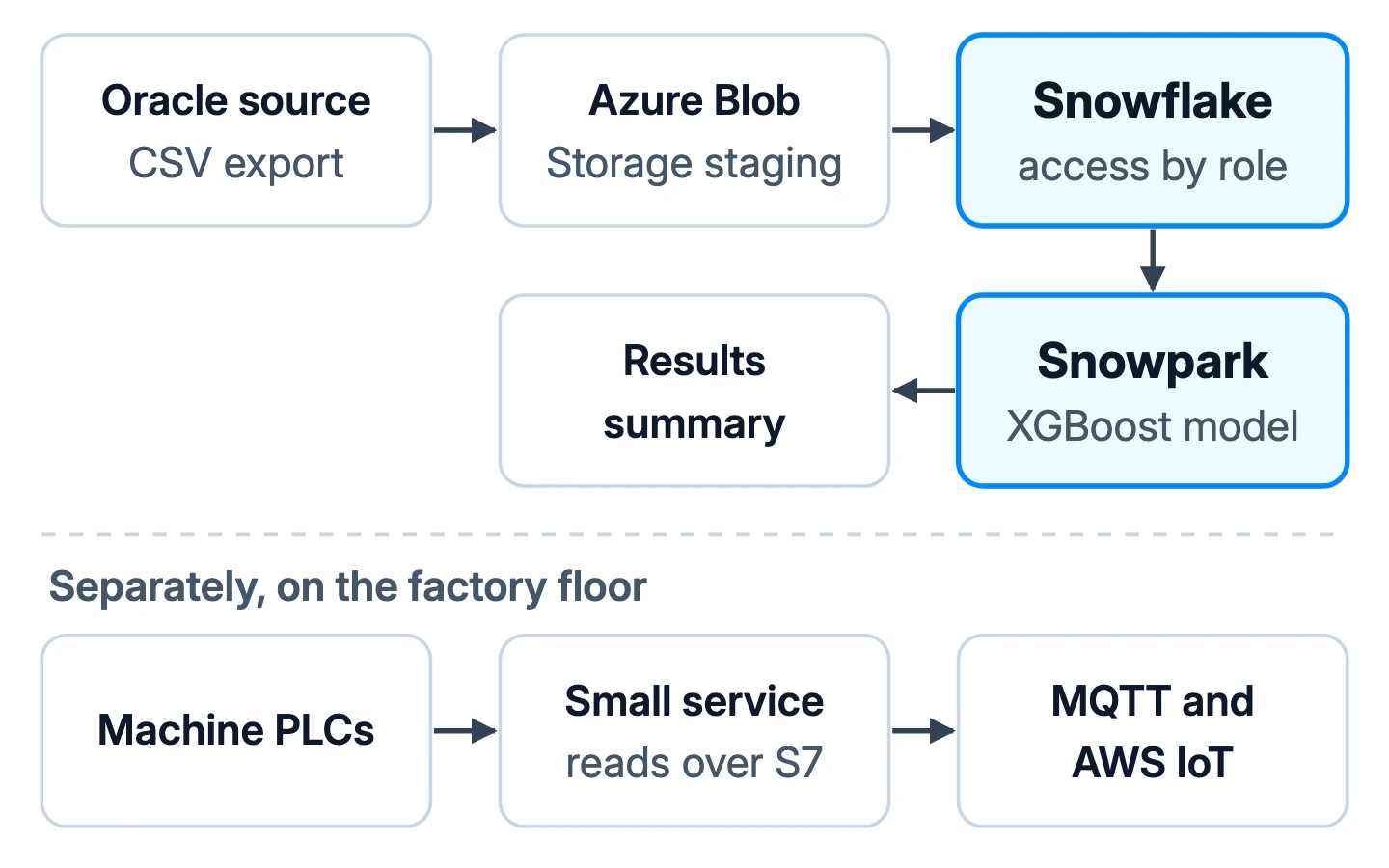
The first part is an extract-and-load pipeline in Python. Production records were exported from the source database, an Oracle system, to CSV files and staged in Azure Blob Storage. From there, each file went to the Snowflake table stage for its content (extrusion runs or defect records) and was loaded with COPY INTO. Files already loaded were skipped, and the staging area was cleaned up afterwards. He also made a version that runs on dummy data with a local database in Docker, so the whole flow could be shown without any client data.
The second part is the Snowflake workspace itself, set up as code: warehouses, the database and schema, file formats and table stages. Access ran through read-only, read-write and analyst roles, with grants that covered current and future tables.
The third part is the analysis, written in Snowpark with Python, pandas and scikit-learn: an exploratory look at the data, a correlation study, and a multi-output XGBoost regression that relates extrusion features to the defect percentage for each defect code. The model was registered in Snowflake's model registry.
The fourth part is a one-page results summary, built in React with TypeScript, Vite and Tailwind CSS. It sets out the findings, the limits of the data and the next steps.
Separately, a small service ran on a device on the factory floor. It read data blocks from the machines' controllers (PLCs) over the S7 protocol, on a heartbeat and on group triggers, and published them over MQTT and AWS IoT. It shipped as a Docker image, with a nightly job that kept it up to date.
The result
At the end, the extrusion and defect records sat in Snowflake under role-based access and could be analysed together. A first model related extrusion data to defect percentages, and the summary named what the data showed and where its limits lay.
The work stayed at the proof-of-concept stage. No production rollout or business result is claimed.
See also
Want something like this built?
Book a free first callLast updated:
All projects