PAP Center: a custom CRM for a hair-loss centre in Thessaloniki
A project by our founder.
- Client
- PAP Center
- Sector
- Hair loss and hair prosthetics
- Location
- Thessaloniki, Greece
- Period
- July 2026 to today
- Status
- In use since September 2026
- Platforms
- Web app, Greek interface
- Stack
- Next.js, Bun, PostgreSQL, AWS, Vercel
The situation
PAP Center is a hair-loss and hair prosthetics centre in Thessaloniki. By its own account it was founded in the early 1980s. It specialises in thickening thin hair for women and men with hair prosthetics, fits wigs, and sells hair and wig care products.
The centre kept its customers, stock, expenses and reports in an old program built for Windows XP. That program no longer worked properly on current Windows, and the centre was afraid it would stop working altogether.
The people who would use its replacement are not technical users, so the new system had to be calm and easy to read.
What was built
Our founder built PAP Center a custom web CRM with a Greek interface. It serves the shop and service side of the business: products, hairpieces, wigs and services. Its screens are Home, Customers, Inventory, Expenses, Reports and Settings, with a quick action for recording a new transaction.
The customer list has category filters that are remembered between visits, accent-insensitive search, autocomplete for city and profession, a warning when a new customer may be a duplicate, and drafts that survive leaving the form.
Each customer card reads like a bank statement. Every entry is one transaction that carries both the charge and the amount paid, with a running balance in red or green. Everything saved in one go shows as one entry. A transaction can be products, services, an advance payment, a payment on account or a no-stock entry, and each one records how it was paid.
Inventory holds products and services, categories such as wigs, hairpieces and care products, purchase and sale prices, purchases from suppliers, product photos and stock per location. Barcodes can be scanned with a scanner that works like a keyboard. Expenses carry their uploaded receipts, and the reports show outstanding balances and income, expenses and net per month or year.
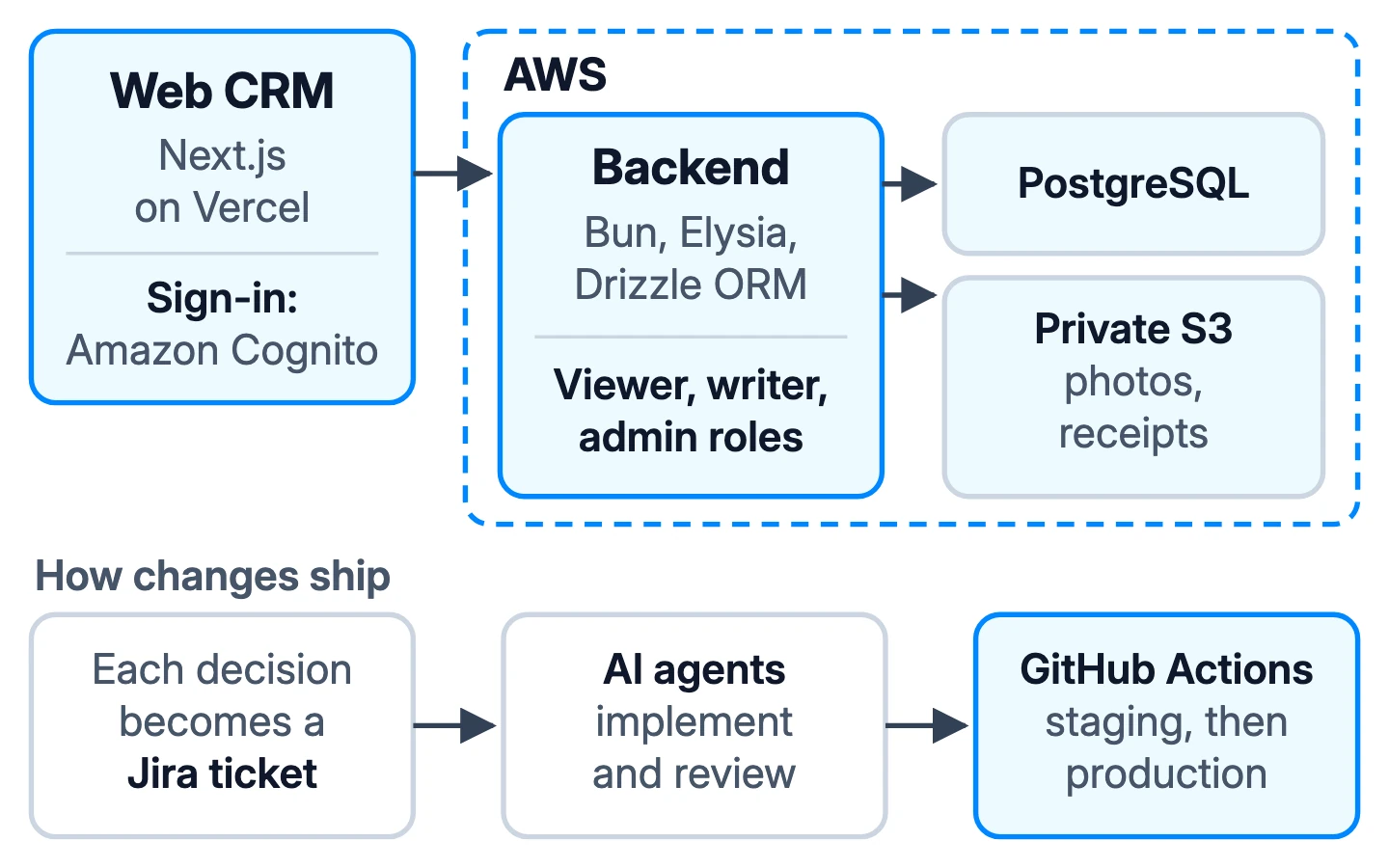
An admin creates every account, and each user is a viewer, a writer or an admin. Both the screens and the backend enforce those roles.
A front-end demo on mock data came first, in June 2026. Work on the production app, on a real backend, began in July 2026 and kept the demo's look and feel. Data from the old program is entered by hand.
The owner decides what changes, and each decision becomes a Jira ticket. AI agents implement and review the change, and the documentation lives in Confluence. Each approved change deploys to staging first, then to production, and database migrations run as a Kubernetes job before each rollout.
The frontend is Next.js with TypeScript, Tailwind and TanStack Query, hosted on Vercel, with sign-in through Amazon Cognito. The backend runs Bun, Elysia and Drizzle ORM on PostgreSQL and verifies every sign-in token against Cognito. On AWS, the backend runs on EKS and the database on RDS, with private S3 storage for product photos and receipts. GitHub Actions runs the pipeline.
The result
The CRM replaced the old Windows program. It went live in September 2026, and the staff use it every day.
Changes have shipped every week since July 2026, and the work continues.
See also
Want something like this built?
Book a free first callLast updated:
All projects