Camunda 7 Forks Compared: CIB seven, Operaton and Staying Put
The Camunda 7 Community Edition ended in October 2025. For the Enterprise Edition, Camunda maintains 7.24 LTS until April 2030. In Camunda 7, the engine can run as a Java library inside your own application. Camunda 8 gave that architecture up, and the forks keep it.
This article compares the two forks with reliable documentation, CIB seven and Operaton, and sets them against a third path: staying on Camunda 7. Everything here comes from each vendor’s own documentation or from GitHub metadata, and was checked on 29 October 2026.
Short answers
- What is a Camunda 7 fork?
- A project that took the open source code of the Camunda 7 Community Edition and develops it on its own. The engine stays a Java library that runs inside your application. Operaton, for example, keeps the database schema of the Camunda 7 Community Edition.
- Why consider a fork at all, when Camunda 8 exists?
- Camunda 8 does not support the embedded engine mode. If your application contains the engine as a library, a fork is structurally the shorter route.
- Do the forks cost anything?
- Operaton describes itself as entirely free: no licence fees, no usage limits and no commercial tier, with production use included. CIB seven has an open source core. CIB publishes no prices for its commercial tiers.
- What is the biggest drawback of each fork?
- For Operaton, it is the support model. The project itself has no LTS line, and each release is supported for a rolling window of six months. Listed service providers can offer extended maintenance and SLAs. For CIB seven, it is the exact version you must be on before you switch.
- Has Camunda acknowledged the forks?
- Not in any Camunda source we read on 29 October 2026: none of them mentions a fork. In those sources, Camunda neither endorses nor rejects them.
Why the forks exist
Camunda has published nothing for the Community Edition since its final release, 7.24, on 14 October 2025, security patches included. The repository is archived. If you run the Community Edition, your installation receives no further fixes from Camunda. The full dates for every version are in Camunda 7 end of maintenance per version.
Camunda 8 is the vendor’s answer, and it changes the architecture. Camunda’s own migration guide says that “the workflow engine in Camunda 8, Zeebe, is always a remote resource for your application, while the embedded engine mode is not supported.” A fork keeps the architecture you have. If your engine is embedded, that is the whole difference.
The two forks side by side
| CIB seven | Operaton | |
|---|---|---|
| Core licence | Apache 2.0, per the GitHub repository | Apache 2.0, per the GitHub repository and Operaton’s own FAQ |
| Cost | Commercial tiers exist; their prices are not published | “There are no license fees, no usage limits, and no commercial tier”, and the FAQ goes on: “you can use Operaton in production, including for commercial purposes, at no cost.” |
| Migration path | Documented, with a migration script built on the OpenRewrite Maven plugin | Documented in five steps, with the same database schema: “Operaton uses the same database schema as Camunda 7 CE.” |
| Prerequisite | An exact version: “The backend of CIB seven 2.1.0 is based on Camunda 7.24.0, so before the migration, please check your Camunda version: it should be Camunda 7.24.0.” The section “Migration to CIB seven 2.2” names the same version. | Also 7.24: “Upgrade to Camunda 7 CE version 7.24, which is the latest release before its end of life.” |
| Long-term support | LTS and Enterprise tiers: 18 months of maintenance per release. Community and Community+: 6 months, per CIB’s pricing page | The project’s own answer: “Operaton itself does not offer a traditional LTS line; the rolling 6-month support window is the model. Listed Service Providers can offer extended maintenance and SLAs for organizations that need long-term stability.” |
| Project activity | Repository active, last pushed on 29 October 2026 | Repository active, last pushed on 29 October 2026 |
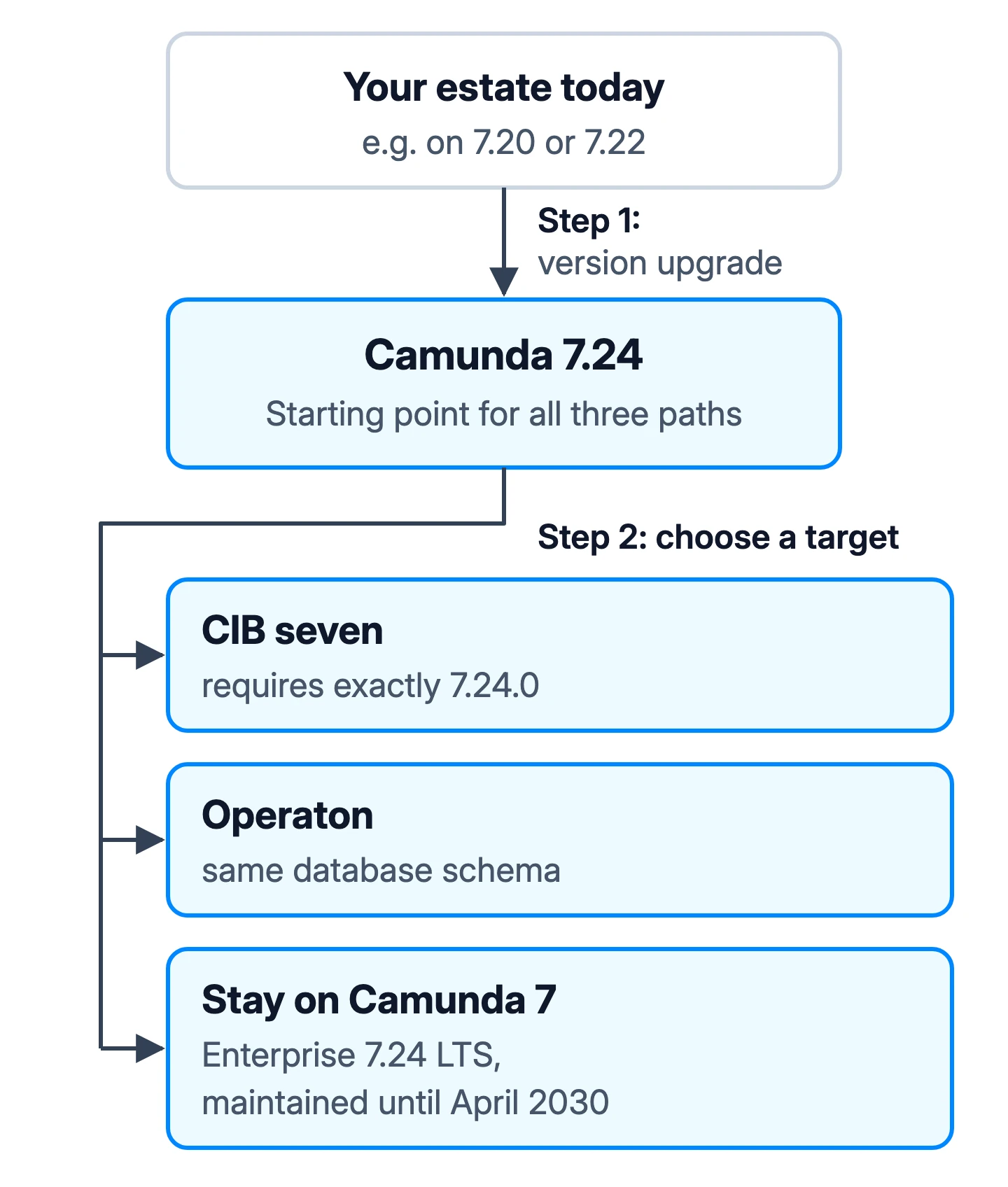
Both forks start from Camunda 7.24. In practice that is the most important row in the table. If you are on 7.20 or 7.22 today, an ordinary version upgrade comes before either fork. For the Enterprise Edition, the same upgrade also leads back into maintenance. Operaton documents its migration from the Community Edition: its first step reads “Upgrade to Camunda 7 CE version 7.24”. Neither fork’s migration guide names an Enterprise-only component. If you run the Enterprise Edition, assess those components on their own before you choose a fork.
The case against Operaton: the support model
Operaton answers the question plainly in its own FAQ: “Operaton itself does not offer a traditional LTS line; the rolling 6-month support window is the model. Listed Service Providers can offer extended maintenance and SLAs for organizations that need long-term stability.” (operaton.org/faq)
Your operations manual may have to commit to a security patch window. A project model that asks for an upgrade every six months cannot carry that commitment alone. In that case, extended maintenance can come from one of the listed service providers. They are independent companies, and you engage them directly. If your team upgrades regularly anyway, the six-month window costs you little.
The other side of the ledger is documented too: free of charge, no usage limits, production use allowed and the same database schema. If your estate ran the Community Edition without licence fees, Operaton leaves that cost structure as it is, because it has no commercial tier. CIB seven also offers an open source Community edition. CIB provides its patch-level updates only to Community+ and Enterprise customers, though.
The case against CIB seven: the exact version prerequisite
CIB documents the switch and supplies a script built on the OpenRewrite Maven plugin. The prerequisite is narrow, though: “The backend of CIB seven 2.1.0 is based on Camunda 7.24.0, so before the migration, please check your Camunda version: it should be Camunda 7.24.0.” (docs.cibseven.org)
The newest line is CIB seven 2.2, with GitHub release v2.2.0 on 1 June 2026. The migration page now has its own section for it, “Migration to CIB seven 2.2”. That section names the same prerequisite: “it should be Camunda 7.24.0”.
This matters for planning. The switch becomes a two-step move: first to 7.24, then to the fork. Depending on the age of your estate, the first step can be the larger of the two. It is also the step you gain from in any case. It takes you back into the only Camunda 7 line still maintained for the Enterprise Edition.
The third path: staying on Camunda 7
You can stay on Camunda 7 with a paid Enterprise subscription on 7.24 LTS. Your code stays as it is and you keep your vendor. For the Enterprise Edition, maintenance of 7.24 LTS runs until April 2030.
We name this path on purpose, although it brings us no migration project, because for some readers it is the right answer. It costs licence fees, and Camunda publishes no price for them. It also moves the decision several years down the road. Either of those can be exactly what you need.
In a forum post (current revision 25 July 2025), Camunda named three routes for Community Edition users who want patches after October 2025. Among them were an upgrade to the Enterprise Edition and a free licence through its community programmes. On 29 October 2026, however, none of the three programme pages named a licence for Camunda 7. That day the Educational License Program was taking no new applications, and new Champion applications were paused. Camunda’s three routes are also listed in Camunda 7 end of maintenance per version.
How do you decide between the three?
- Check your edition. On the Enterprise Edition with 7.24 LTS, maintenance runs until April 2030 and no date forces a move. On the Community Edition, you have received nothing since October 2025, and the decision is due.
- Check how the engine runs. If the engine is embedded, the forks have the structural advantage. If it already runs as a separate service, your application already talks to a remote engine, which is how Camunda 8 always works.
- Check your constraints. If you need an assured support window from the project itself, Operaton’s rolling six-month window drops out, however good the software is. Extended maintenance can then come from a listed service provider. CIB seven’s Community and Community+ editions also maintain each release for six months; its LTS and Enterprise tiers give 18 months.
- Plan for the move to 7.24 in every case. Both forks require it, and Camunda’s route back into Enterprise Edition maintenance runs through it too.
Compare the forks against your own setup
The migration check asks up to 18 questions about your Camunda 7 setup. It shows what each answer means for Camunda 8, CIB seven, Operaton and staying on Camunda 7 Enterprise. Nothing is sent.
Camunda 7 migration checkWe run these four checks on your own estate
We read your Camunda 7 installation and tell you in writing which target fits and why the others drop out.
Camunda 7 migrationIf a process alongside your estate is done by hand, you can have that process automated; two weeks after the kickoff workshop it runs.
If you first want to know what Camunda 8 does differently in its architecture, Camunda 7 vs Camunda 8 walks through the documented differences.
Sources
- Operaton, FAQ (licence, cost, migration steps, support window, service providers, database schema) (retrieved 29 October 2026): https://operaton.org/faq/
- Operaton, Service Providers (list of independent service providers) (retrieved 29 October 2026): https://operaton.org/service-providers/
- Operaton, Impressum (who stands behind the project) (retrieved 29 October 2026): https://operaton.org/legal/
- GitHub, operaton/operaton (Apache-2.0, active, last pushed 29 October 2026) (checked 29 October 2026): https://github.com/operaton/operaton
- CIB seven, “Camunda Migration” (migration script, version prerequisite, sections “Migration to CIB seven 2.1” and “Migration to CIB seven 2.2”) (retrieved 29 October 2026): https://docs.cibseven.org/manual/latest/update/camunda/
- CIB seven, home page (“strategisches Kernprodukt der CIB software GmbH”, a strategic core product of CIB software GmbH) (retrieved 29 October 2026): https://cibseven.org/
- CIB seven, Pricing (Community, Community+, LTS and Enterprise editions, maintenance per release, no prices published) (retrieved 29 October 2026): https://cibseven.org/en/pricing/
- CIB seven documentation, “Patch Level Update” (patch-level updates only for Community+ and Enterprise customers) (retrieved 29 October 2026): https://docs.cibseven.org/manual/latest/update/patch-level/
- CIB software GmbH, Impressum (Rosenkavalierplatz 5, München; register court Munich) (retrieved 29 October 2026): https://www.cib.de/impressum/
- GitHub, cibseven/cibseven (Apache-2.0, active, last pushed 29 October 2026) (checked 29 October 2026): https://github.com/cibseven/cibseven
- GitHub, cibseven/cibseven, release v2.2.0 (1 June 2026, newest release on 29 October 2026) (retrieved 29 October 2026): https://github.com/cibseven/cibseven/releases/tag/v2.2.0
- Camunda, Support Announcements (end of maintenance per version, 7.24 LTS, end of maintenance for Camunda 7.23 in October 2026) (retrieved 29 October 2026): https://docs.camunda.org/enterprise/announcement/
- Camunda blog, “Camunda 7 Enterprise End of Life (EoL) Extension Announcement” (no further Community Edition releases, security patches included) (retrieved 29 October 2026): https://camunda.com/blog/2025/02/camunda-7-enterprise-end-of-life-extension/
- Camunda 8 documentation, “Conceptual differences” (engine always a remote resource, embedded mode not supported) (retrieved 29 October 2026): https://docs.camunda.io/docs/guides/migrating-from-camunda-7/conceptual-differences/
- GitHub, camunda/camunda-bpm-platform (archived) (checked 29 October 2026): https://github.com/camunda/camunda-bpm-platform
- Maven Central, org.camunda.bpm:camunda-engine, maven-metadata.xml (version list ends at 7.24.0) (retrieved 29 October 2026): https://repo1.maven.org/maven2/org/camunda/bpm/camunda-engine/maven-metadata.xml
- Camunda forum, “Important Update: Camunda 7 Community Edition End of Life Announced” (the three routes to further patches, free community licence; current revision 25 July 2025) (retrieved 29 October 2026): https://forum.camunda.io/t/important-update-camunda-7-community-edition-end-of-life-announced/50921
- Camunda, “Camunda 8 Self Managed Non-Commercial License” (redirect target of camunda.com/common-good) (retrieved 29 October 2026): https://camunda.com/pricing/c8sm-non-commercial-license/
- Camunda, “Camunda Champion Program” (redirect target of camunda.com/champions; new applications paused) (retrieved 29 October 2026): https://camunda.com/developers/champions/
- Camunda, “Camunda Educational License Program” (no new applications) (retrieved 29 October 2026): https://camunda.com/educationee/