Camunda 7 vs Camunda 8: What Actually Changes
The most important sentence in this comparison comes from Camunda itself, in its official migration guide: “It is important to understand that Camunda 8 is not a drop-in replacement for Camunda 7.” Camunda 8 is a separate platform, with a different engine, a different API and a different operating model.
How big the difference is for you comes down to one question. Does your engine run inside your application today, or beside it? If it runs beside it, the move is a project. If it runs inside it, the move is a rebuild.
Short answers
- Is Camunda 8 an upgrade from Camunda 7?
- Camunda’s own guide says that Camunda 8 “is not a drop-in replacement for Camunda 7”. Camunda describes it as “a complete rewrite of Camunda 7”, with a different engine and a different API.
- What is the biggest technical difference?
- In Camunda 8 the engine is always a remote resource, according to Camunda, and the embedded mode is not supported. As a result, your code and the engine can no longer share a technical transaction.
- Can I take my BPMN models with me?
- Partly, and Camunda provides the Diagram Converter for them. Camunda’s guide says you might have to adjust your BPMN models. Most expressions can be converted, and some may need a complete rewrite.
- What is hardest to migrate?
- Camunda names them itself: casts to implementation classes, ThreadLocals, relying on a specific transaction manager, and Spring beans hidden behind JUEL expressions. Camunda calls these “the real showstoppers”.
- Do I have to switch?
- Not necessarily. For the Enterprise Edition, maintenance of 7.24 LTS runs until April 2030. Camunda 7 Community Edition reached end of life in October 2025, and its final release, 7.24, shipped on 14 October 2025. On the Community Edition, that forces a decision, and Camunda 8 is one of the options for it.
The one difference all the others follow from
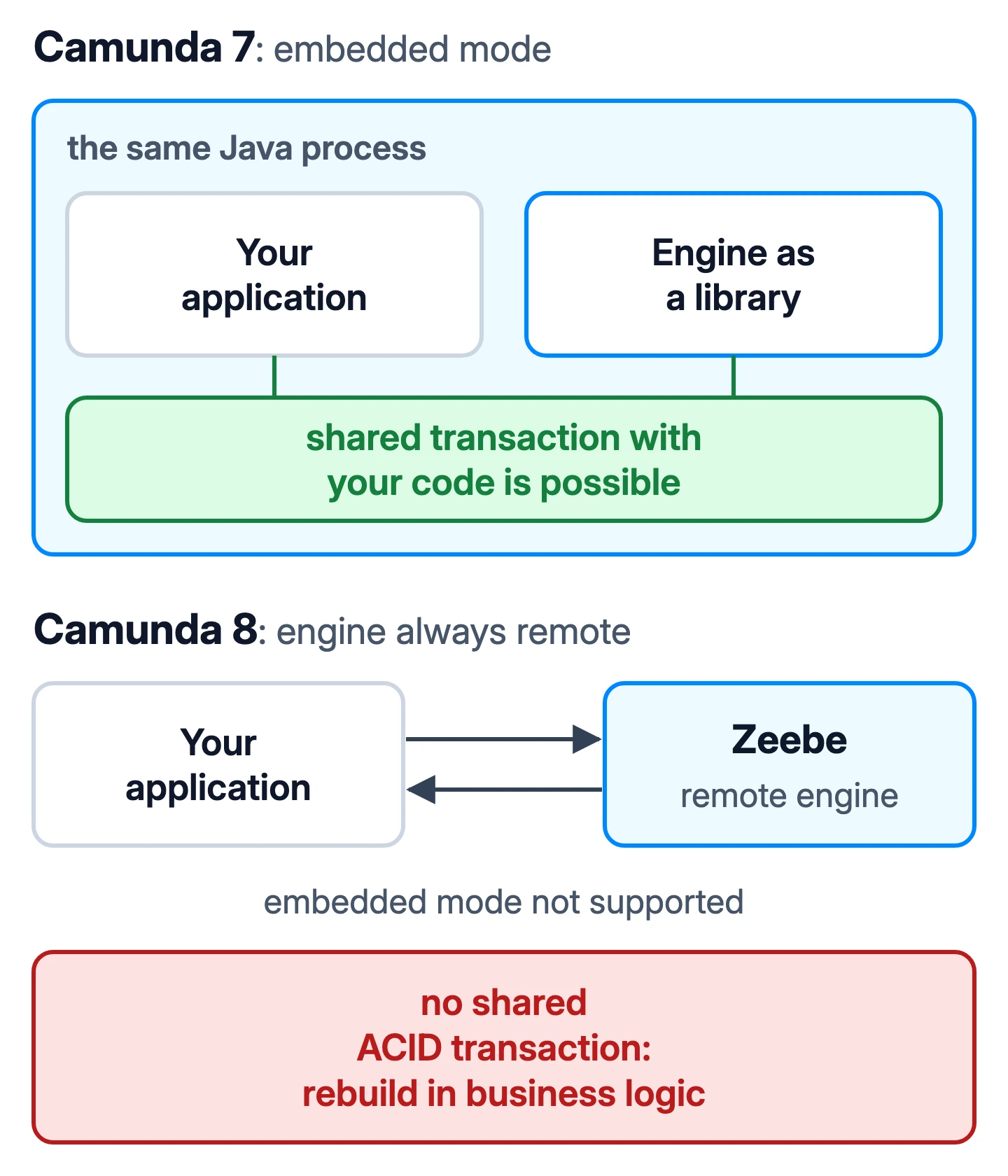
Camunda 7 lets you embed the engine as a library in your application. Both then run in the same Java process, share thread pools and can use the same data source and transaction manager. For Camunda 8, the documentation says: “the workflow engine in Camunda 8, Zeebe, is always a remote resource for your application, while the embedded engine mode is not supported.” (docs.camunda.io, Conceptual differences)
The same page names the consequence, and calls it conceptually “the only big difference”: “with a remote engine, you cannot share technical ACID transactions between your code and the workflow engine.” Your application may rely on a database write and a process step succeeding or failing together. That behaviour then has to be rebuilt in your business logic.
Wherever your application quietly depends on that shared transaction today, someone has to make a design decision. Those places live in your code, so finding them means reading the code.
What Camunda itself names as showstoppers
Camunda’s page on migration-ready solutions contains a remarkably frank paragraph (docs.camunda.io, Migration-ready solutions): “Given that Java delegates and the workflow engine are embedded as a library, projects can do dirty hacks in their code. Casting to implementation classes? No problem. Using a ThreadLocal or trusting a specific transaction manager implementation? Yeah, possible. Calling complex Spring beans hidden behind a simple Java Unified Expression Language (JUEL) expression?” That one too, Camunda says, is “doable!”
And the sentence after it: “Those hacks are the real showstoppers for migration, as they cannot be migrated to Camunda 8.”
Look past the dismissive tone. If your estate grew up on an embedded engine, these “dirty hacks” are simply what the engine allowed for years. They may well be the part of your estate that nobody has documented. The honest consequence: the number of process models tells you little about the effort of a migration. Your Java code, where these patterns live, sets it.
Which tools Camunda provides
Camunda documents its own set of tools for the move to Camunda 8 (docs.camunda.io, Migration tools). The page opens: “Camunda is invested in supporting and easing your migration from Camunda 7 to Camunda 8 with migration tools.” That is a real advantage of this route, and it belongs in any fair comparison.
| Tool | What it does | What stays with you |
|---|---|---|
| Camunda migration agent skill | Camunda lists it as “Agentic migration (recommended)”: “An AI coding agent uses the Diagram Converter for models and forms, lets you select an AI-first or recipe-assisted Java migration path, and migrates your tests to Camunda Process Test (CPT).” | Reviewing every conversion. Camunda writes: “Review every conversion and rearchitect your solution where needed.” |
| Diagram Converter | Analyses and converts BPMN and DMN models and Camunda 7 forms for Camunda 8 | Checking, in business terms, that the converted model does what the old one did |
| OpenRewrite recipes | An optional path, in Camunda’s words: a deterministic first diff for “repeated, supported, primarily syntactic Java transformations” | Changes in behaviour, above all the showstoppers above. Camunda writes that OpenRewrite “does not complete a migration”. |
| Data Migrator | In Camunda’s words, it “Copies Camunda 7 runtime instances and history (audit log) to Camunda 8.” | Deciding which running instances to bring over at all |
Expect from these tools what you would expect from a compiler. They take over the mechanical work and leave the decisions with you.
Licensing and production use: a separate running cost
For the Camunda 7 Community Edition, Camunda states that “the entire software is provided under various open source licenses (mainly Apache 2.0 and MIT)”. For Camunda 8, the source code of the core components is under the Camunda License v1, and the compiled software under a proprietary licence. For production, Camunda writes: “To use the software in production, purchase the Camunda Self-Managed Enterprise Edition.” (docs.camunda.io, Licensing)
For an estate on the Community Edition, this is the real change. An open source library becomes a platform that needs a licence in production, plus a cluster that someone has to run. Together they become a running cost, on top of the project budget. Camunda publishes no price for this, and we publish none here either.
The comparison at a glance
| Camunda 7 | Camunda 8 | |
|---|---|---|
| Engine | Java library: embedded, shared in a container, or a standalone server | Zeebe, always remote; embedded mode not supported |
| Transactions | a technical transaction shared with your code is possible | no shared technical transaction; to be rebuilt in business logic |
| Models | BPMN 2.0, run by the engine’s BPMN 2.0 core | BPMN, converted with the Diagram Converter; some expressions need rewriting |
| Licence (core) | Community Edition under open source licences, mainly Apache 2.0 and MIT | source code under the Camunda License v1; production use requires the Enterprise Edition |
| Life cycle | Community Edition: end of life in October 2025; 7.24 LTS maintained for the Enterprise Edition until April 2030 | the line Camunda is actively developing; documentation at version 8.10 |
When switching is not the right answer
We sell Camunda 7 migrations, which is exactly why this section is here. In the cases below, a switch to Camunda 8 is not the obvious decision.
First: you run 7.24 LTS with an Enterprise subscription. Then Camunda maintains 7.24 LTS for the Enterprise Edition until April 2030. For the Enterprise Edition, Camunda keeps shipping patch releases and Environment Update Releases with newly supported environments. No date forces you into anything. Anyone selling you urgency in that position is selling you a date Camunda has not published.
Second: your engine is deeply embedded. Then the move to Camunda 8 is the rebuild described at the top. Camunda’s guide says the effort “greatly depends on how your existing Camunda 7 solution is built”. The showstoppers above grow out of the embedded design. The forks of the Community Edition deserve at least a look before you commit, and Camunda 7 Forks Compared sets them side by side. Which targets exist, and the case against each one, is set out in Camunda 7 end of maintenance per version.
Your own estate settles both cases. A comparison table, ours included, is only the starting point for that check. If a process alongside your estate is still done by hand, you can have that process automated, live two weeks after the kickoff workshop.
Check how embedded your own setup is
The migration check asks up to 18 questions about your Camunda 7 setup. It shows what each answer means for Camunda 8, CIB seven, Operaton and staying on Camunda 7 Enterprise. Nothing is sent.
Camunda 7 migration checkYour code decides which route fits your estate
We read your Camunda 7 setup and tell you which target fits it, and why the others drop out.
Camunda 7 migrationIf you are still unsure which of the two products you actually run, What is Camunda? gives four quick checks. Only the first one needs access to your code.
Sources
- Camunda 8 documentation, “Camunda 7 to Camunda 8 migration guide” (overview, docs version 8.10) (retrieved 29 October 2026): https://docs.camunda.io/docs/guides/migrating-from-camunda-7/
- Camunda 8 documentation, “Conceptual differences” (remote engine, transactions) (retrieved 29 October 2026): https://docs.camunda.io/docs/guides/migrating-from-camunda-7/conceptual-differences/
- Camunda 8 documentation, “Migration-ready solutions” (showstoppers) (retrieved 29 October 2026): https://docs.camunda.io/docs/guides/migrating-from-camunda-7/migration-readiness/
- Camunda 8 documentation, “Migration tools” (agentic migration as the recommended route, Diagram Converter, Data Migrator) (retrieved 29 October 2026): https://docs.camunda.io/docs/guides/migrating-from-camunda-7/migration-tooling/
- Camunda 8 documentation, “Code Conversion” (Camunda 8 as a complete rewrite; OpenRewrite as an optional recipe-assisted path; review every conversion) (retrieved 29 October 2026): https://docs.camunda.io/docs/guides/migrating-from-camunda-7/migration-tooling/code-conversion/
- Camunda 8 documentation, Licensing (retrieved 29 October 2026): https://docs.camunda.io/docs/reference/licenses/
- Camunda 7 documentation, Licenses (retrieved 29 October 2026): https://docs.camunda.org/manual/7.24/introduction/licenses/
- Camunda 7 documentation, Architecture Overview (retrieved 29 October 2026): https://docs.camunda.org/manual/7.24/introduction/architecture/
- Camunda, Support Announcements (end of maintenance per version, including Camunda 7.23 in October 2026) (retrieved 29 October 2026): https://docs.camunda.org/enterprise/announcement/
- Camunda, Release Policy (patch releases only for Enterprise customers) (retrieved 29 October 2026): https://docs.camunda.org/enterprise/release-policy/
- Camunda, Pricing (“Talk to sales”, no price figure) (retrieved 29 October 2026): https://camunda.com/pricing/
- Maven Central, org.camunda.bpm:camunda-engine, maven-metadata.xml (version list ends at 7.24.0, index last updated 14 October 2025) (retrieved 29 October 2026): https://repo1.maven.org/maven2/org/camunda/bpm/camunda-engine/maven-metadata.xml
- Camunda forum, thread 60208, the Community Edition end of life clarification (end in October 2025, no releases after it; opened 28 February 2025) (retrieved 29 October 2026): https://forum.camunda.io/t/camunda-7-community-end-of-life-eol-clarification/60208